Road vs Gravel vs MTB: What to Choose for Adventure Cycling Expeditions

April 9, 2026

Road vs Gravel vs MTB: What to Choose for Adventure Cycling Expeditions
Choosing the right bike is one of the most important decisions when planning an adventurecycling expedition. Whether you're riding across highways, exploring remote trails, ortackling multi-terrain routes, your bike determines comfort, speed, and overall experience. At Oxbow Explore, our multi-terrain adventure cycling expeditions often combine pavedroads, dirt tracks, forest trails, and rugged climbs which makes selecting between roadbikes, gravel bikes, and mountain bikes crucial. This guide helps you decide what works best for your cycling expedition in India. 1. Road Bike Best for Speed Long Distance Highways Road bikes are designed for smooth tarmac and long-distance endurance. They arelightweight, fast, and efficient. Best For- Highway cycling expeditions- Long-distance endurance rides- City-to-city cycling routes- Supported cycling expeditions- Flat terrain routes Advantages- Fastest option for long distances- Lightweight and efficient- Less effort on paved roads- Ideal for endurance cycling Limitations- Not suitable for rough terrain- Limited tire width- Uncomfortable on gravel or dirt- Fragile for expedition conditions Choose a Road Bike ifYour adventure cycling expedition includes:- 8090% paved roads- Long endurance distances- Minimal off-road terrain- Supported logistics vehicle 2. Gravel Bike Best All-Rounder for Adventure Expeditions Gravel bikes are built for mixed terrain cycling expeditions. They combine speed of roadbikes with durability of mountain bikes. This is often the best choice for multi-terraincycling expeditions Best For- Mixed terrain cycling expeditions- Adventure cycling in India- Bikepacking expeditions- Remote exploration rides- Multi-day cycling journeys Advantages- Handles road + dirt + gravel- Comfortable geometry- Wider tires for stability- Mounts for bags amp; gear- Ideal for long expeditions Limitations- Not as fast as road bikes- Not as capable as MTB in technical terrain Choose a Gravel Bike ifYour expedition includes:- Mixed terrain routes- Long-distance exploration- Bikepacking- Forest trails amp; dirt roads- Multi-day adventure cyclingThis is the most versatile adventure cycling expedition bike. 3. Mountain Bike (MTB) Best for Rugged Terrain Off-Road Expeditions Mountain bikes are built for rough terrain, steep climbs, and technical trails. They are idealfor off-road cycling expeditions. Best For- Off-road cycling expeditions- Mountain terrain- Desert trails- Forest and jungle routes- Technical riding Advantages- Strong and durable- Suspension for comfort- Wide tires for grip- Handles rough terrain easily- Best for remote exploration Limitations- Slower on highways- Heavier than road/gravel bikes- More effort on long distances Choose an MTB if Your expedition includes:- Rough terrain- Mountain trails- Sand / desert riding- Remote off-road routes- Technical riding sections What Oxbow Explore Recommends For most Oxbow Explore adventure cycling expeditions, we recommend: Gravel Bike Best Overall Choice Because our expeditions typically include:- paved roads- broken roads- dirt trails- forest tracks- offbeat routes Gravel bikes handle multi-terrain adventure cycling most efficiently.However:- Choose Road Bike endurance highway expeditions- Choose MTB rugged off-road expeditions Explore Adventure Cycling with Oxbow Explore Join Oxbow Explore cycling expeditions designed across mountains, forests, deserts andremote terrain. Our multi-terrain adventure expeditions are built for endurance, explorationand real adventure.
read more arrow
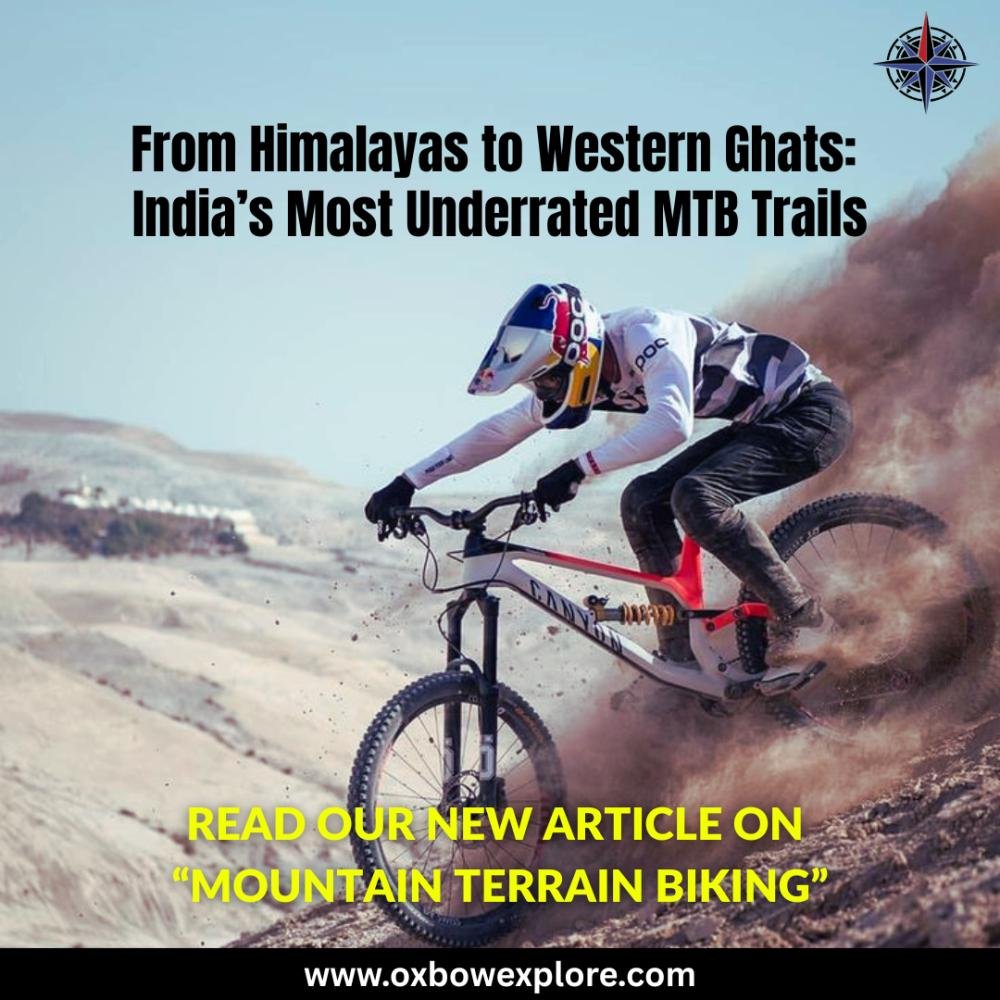
From Himalayas to Western Ghats: India’s Most Underrated MTB Trails

March 5, 2026

From Himalayas to Western Ghats: India’s Most Underrated MTB Trails
Indias mountain biking story is often told through familiar namesManali, Ladakh, and Ooty. But beyond the spotlight lies a network of raw, lesser-known trails that deliver something far more powerful: solitude, technical terrain, and the feeling of true exploration. From Oxbow Explores lens, these underrated MTB routes arent just rides; theyre immersive mountain experiences. 1. High-Altitude Grit in Spiti Valley If youre chasing thin air and big landscapes, Spiti delivers in silence and scale. Unlike the busier circuits of Manali-Leh, Spitis gravel roads and broken mountain tracks feel untouched. Expect: Long, lung-testing climbs above 3,500m Loose switchbacks carved into stark brown cliffs High-speed descents on cold desert terrain Why its underrated:Spiti is often seen as a road-trip destination, not a technical MTB zone. But its rugged jeep tracks and remote village connectors offer incredible bikepacking potential for riders seeking endurance and isolation. Adventure takeaway: This is where you test oxygen, patience, and mental resilience. 2. Coffee Trails Red Mud in Coorg Hidden inside coffee plantations and forest corridors, Coorgs rolling terrain is a playground of flow and surprise. During dry months, the red dirt trails offer smooth, rhythmic riding. In monsoon season, they transform into slippery technical challenges demanding precise braking and weight control. Expect: Rolling climbs through shaded estates Fast forest descents Occasional wildlife crossings Why its underrated:Overshadowed by road cycling culture in Karnataka, Coorgs MTB potential remains largely community-driven and local. Adventure takeaway: Flow meets unpredictability. 3. Tea Estate Singletracks in Munnar Munnar isnt just misty tea gardens and honeymoon views. Beneath its tourist-friendly exterior lies a network of estate roads and hidden gravel connectors ideal for mountain biking. The terrain offers: Punchy short climbs Rolling ridge-line routes Technical wet-rock descents during monsoon Why its underrated:Most riders head to Ooty, leaving Munnars layered hills relatively unexplored by serious MTB communities. Adventure takeaway: A perfect blend of scenic riding and technical challenge. 4. Desert Gravel Routes Near Jaisalmer Mountain biking doesnt always mean mountains. Around Jaisalmer, desert trails and hard-packed sand routes create a different kind of endurance test. Expect: Wind resistance as your main rival Rolling dune sections Long-distance gravel stretches Why its underrated:Indias MTB narrative rarely includes desert terrain. Yet these routes build stamina, pacing discipline, and mental focus. Adventure takeaway: Silence, horizon, and self-reliance. 5. Weekend Wilderness Around Bengaluru Within 6090 minutes of the city lie granite-strewn hills, forest trails, and rural gravel roads that most weekend riders overlook. Local hotspots offer: Rocky technical climbs Short but intense elevation gains Trail networks shaped by passionate cycling communities Why its underrated:Overshadowed by tarmac-focused cycling groups, off-road riders often have these zones to themselves at sunrise. Adventure takeaway: You dont need a Himalayan expedition to feel wild. 6. Monsoon Technicality in the Western Ghats The Western Ghats as a wholestretching across Maharashtra, Karnataka, Kerala, and Tamil Naduremain one of Indias most underutilized MTB ecosystems. During monsoon, trails become Slippery root sections Mud-heavy endurance zones Visibility-limited jungle corridors Its messy. Its demanding. Its real. Why its underrated:Seasonality discourages many riders. But those willing to adapt their gear and skills unlock unmatched adventure riding. Why These Trails Matter Underrated doesnt mean easy. It means unexplored. These trails represent: Lower traffic Authentic community-driven routes Greater room for discovery Raw terrain that forces skill development From Oxbow Explores perspective, mountain biking isnt about ticking off famous names. Its about chasing terrain that challenges and transforms you.
read more arrow
MOUNTAIN TERRAIN BIKING

February 25, 2025

MOUNTAIN TERRAIN BIKING
MOUNTAIN TERRAIN BIKING Mountain Terrain Biking in India: Exploring Trails Across Diverse Landscapes Indias diverse topography makes it a paradise for mountain terrain biking enthusiasts. From the rugged Himalayan trails to the lush forests of the Northeast, the country offers a variety of routes catering to beginners, intermediates, and expert riders. Heres a detailed look at some of the best MTB trails in India, classified by difficulty levels and altitude. Himalayan Region 1. Manali-Leh Highway (Expert) Altitude: 3,000 m 5,359 m Difficulty: Extreme Terrain: High-altitude passes, steep climbs, and river crossings Highlights: Rohtang Pass, Baralacha La, Tanglang La 2. Spiti Valley Circuit (Intermediate to Expert) Altitude: 2,700 m 4,551 m Difficulty: Advanced Terrain: Rocky roads, desert terrain, and riverbeds Highlights: Kunzum Pass, Key Monastery, Tabo Village 3. Kumaon HillsMukteshwar Bhimtal (Beginner to Intermediate) Altitude: 1,200 m 2,300 m Difficulty: Moderate Terrain: Forest trails, paved roads, dirt tracks Highlights: Nainital Lake, Pine forests, Wildlife encounters Northeast India 1. Meghalaya: Shillong to Dawki (Intermediate) Altitude: 1,500m300m Difficulty: Moderate Terrain: Paved roads, off-road jungle trails Highlights: Living Root Bridges, Dawki River, Mawlynnong 2. Arunachal Pradesh-Tawang Circuit (Expert) Altitude: 3,048 m 4,570 m Difficulty: Hard Terrain: Rocky climbs, snow-covered roads, steep descents Highlights: Sela Pass, Tawang Monastery, Jung Waterfalls 3. Nagaland-Dzukou Valley (Beginner to Intermediate) Altitude: 2,438m Difficulty: Moderate Terrain: Grasslands, winding trails, singletracks Highlights: Seasonal flowers, panoramic valley views Western Ghats South India 1. Coorg-Tadiandamol Brahmagiri (Beginner to Intermediate) Altitude: 900 m 1,748 m Difficulty: Moderate Terrain: Coffee plantations, river crossings, forest trails Highlights: Western Ghats biodiversity, misty landscapes 2. KeralaMunnar to Marayoor (Intermediate to Expert) Altitude: 1,500 m 2,200 m Difficulty: Hard Terrain: Steep inclines, tea estates, dirt roads Highlights: Eravikulam National Park, sandalwood forests Western Central India 1. RajasthanAravalli Hills (Beginner to Intermediate) Altitude: 450 m 1,722 m Difficulty: Moderate Terrain: Sand dunes, rocky paths, desert tracks Highlights: Nahargarh Fort, Kumbhalgarh, rural villages 2. Madhya Pradesh-Pachmarhi Trails (Beginner to Intermediate) Altitude: 1,067 m 1,352 m Difficulty: Moderate Terrain: Dense forests, dirt trails, waterfalls Highlights: Satpura National Park, Jata Shankar Caves 3. Best Time for Mountain Biking Himalayan Region: June September (post-snow melt) Northeast India: October March (dry season) Western Ghats South India: October May Western Central India: November March
read more arrow
arrow
Itineraries Downloads